Protected in South Africa, Europe & the United States

Six filings. One mechanism. Every division runs on it.

The core mechanism — a system for generating a unique tag, scanning it to assign an item to an owner's account, and issuing an electronic receipt that can't be duplicated or forged — is granted and maintained in South Africa. The physical tag design itself is separately protected in South Africa and the European Union, with a United States design patent allowed and awaiting formal issue. It's the single mechanism underneath eReceipts, ScreenSync, and every industry Digitag serves — not a separate invention per division, one invention applied wherever a physical item needs a provable owner.
In Plain English

A normal QR code is generic. Ours is never generic.

Most QR codes you see — on a poster, a menu, a product box — are static: every scan, from every person, resolves to the exact same URL. They're a print shortcut, not a system. What Digitag actually harnesses is the opposite property: every tag we issue is its own unique code, resolving to its own unique URL, wired to its own function in our database. One code, one item, one owner — printed on a label or rendered live on a screen, it doesn't matter which. That's not a feature bolted onto a QR code. It's the entire mechanism the patent below protects.

What's Actually Protected

South African Patent No. 2023/03510 — "System and Method for Managing Ownership and Delivery of Items." Claim 1, the broadest, independent claim, names no specific item.

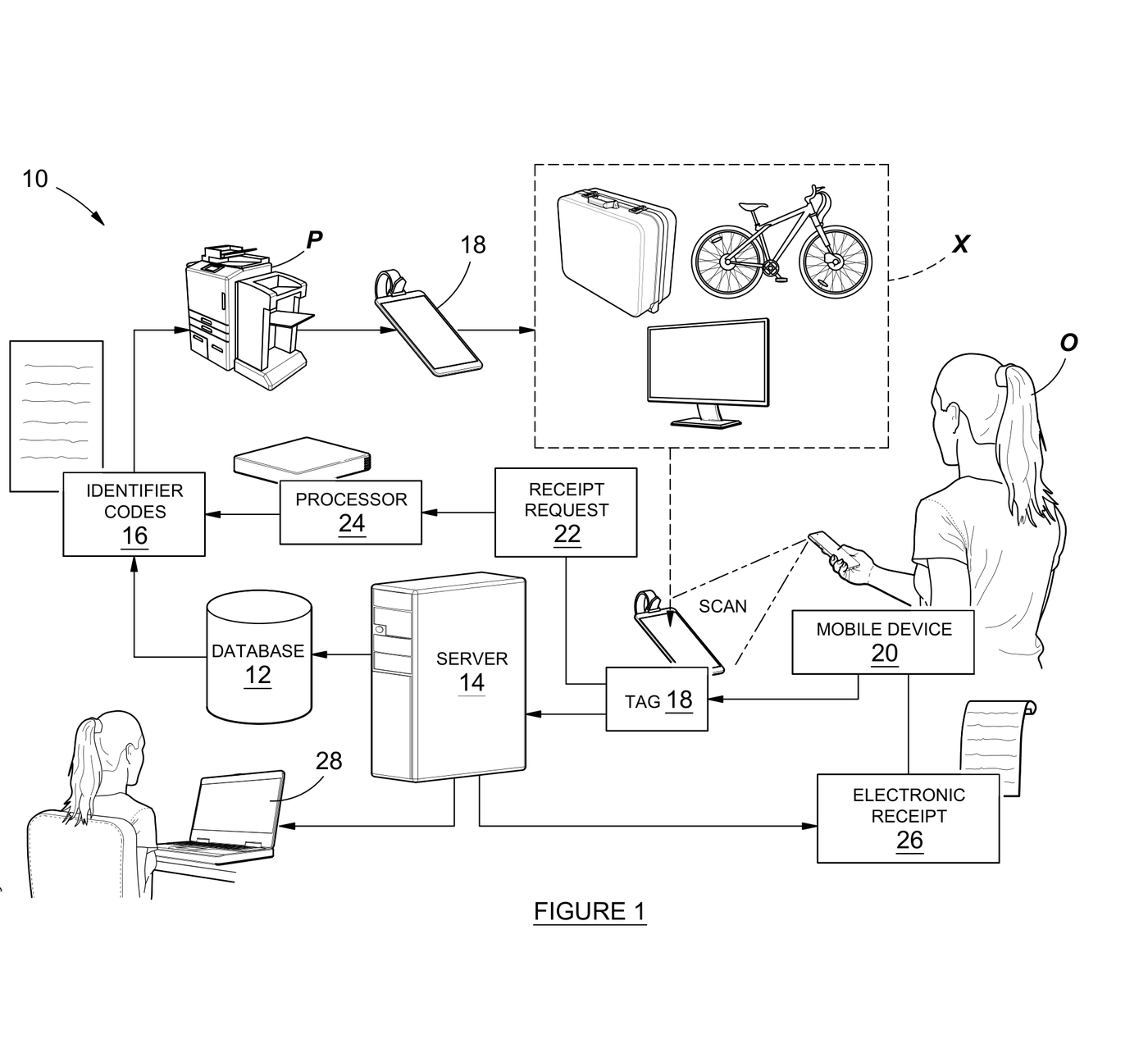
A database of unique identifier codes. A tag bearing a scannable barcode, securable to or integrated with "the item" — no type specified. A processor that takes a scan-triggered request, assigns it to one of those codes, issues an electronic receipt, and stores it permanently. That's the entire independent claim. Dependent claims narrow it for specific cases (a flight number and destination, for instance) — but they don't limit what the core claim covers, and the specification says so directly, in its own words:

"The invention extends to the provision of managing and proving ownership of any item, not just limited to luggage/baggage, televisions or bicycles but to any item on which a physical tag can be secured."

Televisions and bicycles are named explicitly, alongside luggage — not an inference from the accompanying diagram, a direct statement in the patent's own text. The specification also covers the case where there's no separate physical tag at all: "the unique barcode/QR code can be applied by any means, such as be lasered/embossed/engraved onto the item" — precisely how ScreenSync works, where the QR code renders on the screen itself.

The Mechanism
Key Vault Generated
Tags Printed Offline
Scanned by Owner
Ownership Claimed
Receipt Issued

In practice: a batch of unique keys is generated in the cloud ahead of time, each one wired to its own URL. That batch is exported to a spreadsheet and fed into print production, where every tag is printed offline, in bulk, with no scan or claim happening yet — the key sits dormant until it's on a physical item. When the owner scans it for the first time, they claim it: attaching their name and a reference — a flight number, a hotel reservation, whatever applies — to that specific key. One person can claim any number of tags against the same reservation, so a traveller with three bags scans three separate codes, each independently linked back to them. From that point on, the tag is proof: exactly who it belongs to, and when they claimed it — which is what makes it usable as ownership evidence for an insurance claim.

What the claims actually cover, in plain English:

Database of identifier codesThe key vault — a pool of unique codes, generated ahead of time and never reused once claimed
Tag with a barcodeQR code, RFID, or NFC — printed offline in bulk, secured to or integrated with the item
Mobile device scanAny smartphone camera or reader, no app required
Receipt requestSent the instant the owner claims the tag — a name plus a reference like a flight or reservation number
Processor / serverAssigns the request to a code, one time only — one owner can hold multiple claimed tags
Electronic receiptWho, when, and where — permanent, can't be forged or duplicated
Certificate & Drawing
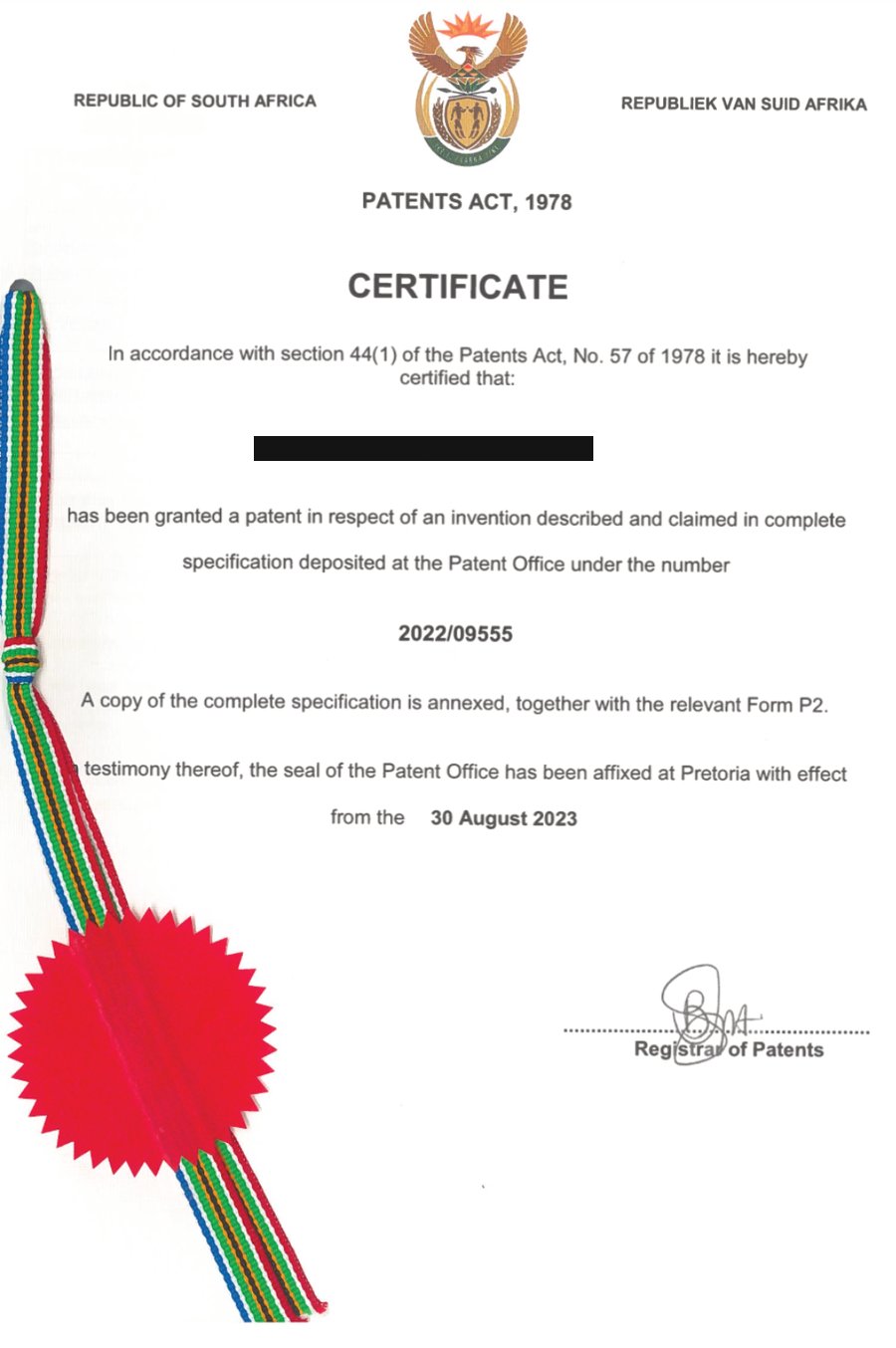
South African Patent Certificate No. 2022/09555, granted 30 August 2023

Certificate of Grant, Patent No. 2022/09555 (Collective Sharing of Data) — Republic of South Africa, Patents Act, 1978.

Figure 1 — system for managing ownership and delivery of items, depicting a television, a bicycle, and luggage as example items

Figure 1, from Patent No. 2023/03510 (Managing Ownership and Delivery of Items) — depicting a television, a bicycle, and luggage as example items.

The Full Portfolio

Six filings, three jurisdictions — the mechanism and the physical tag, each protected in their own right.

SA 2023/03510Managing Ownership and Delivery of Items — granted 27 Sep 2024. The core scan-to-own-to-receipt mechanism.
SA 2022/09555Collective Sharing of Data — granted 30 Aug 2023. The underlying shared-database architecture.
SA A2023/00702 & F2023/00701A Tag Assembly — design registrations granted 27 Mar 2024, covering the physical tag itself.
EU 015042678 (4 variants)A Tag Assembly — Community Design, registered 29 Nov 2023, covering the tag across the EU.
US 29/921,368A Tag Assembly — Design Patent, issue fee paid and awaiting formal grant. Design patents carry no renewal fees once issued.
Across Every Division

The same five elements, mapped onto four different industries.

Travel & Hospitality

The tag is a printed luggage label; the owner is a traveller; the receipt proves the bag is theirs at check-in and at collection. See the eReceipts story →

Screens & Media

The tag is the screen's own on-screen QR code — no separate label exists; the item embosses its own tag, exactly as the specification anticipates. See ScreenSync →

Insurance & Retail

The tag is a pre-printed tamper-proof label; the owner is a policyholder or shopper; the receipt replaces a paper slip that can be lost before it's ever needed. See all industries →

Six filings. Every industry that needs a provable owner.

If your business needs to tie a person to a physical item — without relying on a paper receipt — let's talk about what that would look like for you.

Get in touch