Harness every screen you already own — one network, any industry.
Every TV and laptop you already own becomes a centrally-controlled node on a real-time
network — no box behind the screen, no app to install, nothing new for IT to patch.
One dashboard pushes pricing, promotions, partner content, and whatever else a location
needs to show, across your entire network, updated in seconds. It doesn't matter if
you're a retailer, a hotel group, a vehicle rental operator, or anything else with
screens spread across multiple sites — and because every screen is tied to a real
person's account, not an anonymous device, you know exactly who linked it, when, and
how well your team is managing the network, not just that it's running.
Live PricingPromotionsPartner ContentTeam PerformanceAsset Tracking
Any operator with screens spread across more than one location — the industry doesn't matter.
Retail & Electronics
Price and spec displays for exactly the categories that change weekly — where a wrong price on the floor is an awkward conversation at the till.
Hospitality & Hotels
Lobby and room-facing screens carrying amenity info, promotions, or wayfinding — updated network-wide from one dashboard, not property by property.
Vehicle & Equipment Rental
Fleet availability, rates, and promotions shown live across every branch counter — the same real-time control a retailer gets over pricing.
Brands & Advertisers
A screen already earning its keep on one operator's own content is also a screen that can carry paid content — a new, ready-made advertising surface across any network's floor space.
The Hello Customer Advantage
Built for the reality of a real site with real staff, not a head office in a different country.
Most screen-network solutions rely on a separate device plugged in behind every TV. In
practice, on a real site, that's a liability, not a feature: devices get plugged into
the wrong port, go missing, get stolen, or just fail — and every failure is a support call
to a location that may not have anyone technical on-site. Hello Customer needs none of that. The
screen's own browser is the entire client, so there's nothing extra to plug in, lose, or
steal in the first place — a design built around this reality, not adapted to it:
Nothing extra to buy, ship, install, lose, or have stolen — per screen, per location, forever
No technical setup on-site — if a location's own staff can open a QR code on their phone, they can activate a screen
Nothing new for anyone to hack — no separate device sitting on your network with its own security gaps to patch or forget about
Every screen updates the instant a change is made — no manual rollouts, no waiting, no truck rolls to fix a stuck device
A new screen at a new location can go live in minutes, not weeks of shipping and installing hardware
No setup fee, no onboarding cost, no devices to buy upfront — start on one location or a hundred, and it costs the same to try either way
Zero upfront capital cost to deploy — no hardware purchase to approve or depreciate before a single screen goes live
Turn any screen on or off in seconds, from the dashboard — scale a pilot up or down without buying or shipping anything either way
Costs stay flat as the network grows — nothing per-screen to multiply across hundreds of locations
Verified proof of engagement, not just a promise that content played
What Hello Customer Does
One dashboard, every screen, always up to date.
It's simple: a digital key lets anyone you choose put content into your network — push it
through the API, drop in a file, or have us build it for you — and it goes out across
every screen in your network automatically. Operators spend real money keeping on-screen
information accurate and consistent — a hotel's rate board, a rental fleet's availability,
a retailer's price ticket, whatever a location needs to show. Hello Customer replaces static
signage with a screen the operator already owns, driven from a system they already control:
Central, real-time control of every screen's content, across every location, from one dashboard
Content can be typed in by hand, dropped in as a file, or pushed automatically from the operator's own backend system
A curated content library for paid advertiser slots — negotiated and scheduled independently of everything else on screen
A QR code on any slide, linking through to full detail — a spec sheet, a booking page, whatever fits
No hardware to install — the TV or laptop's own web browser is the entire client
How It Works
A location's TV or laptop opens one Hello Customer URL in its own browser — nothing installed.
The screen shows a QR code. Staff scan it once with a phone to claim it for that location.
The operator updates content in the dashboard, or their own backend pushes it via a simple API key.
Every screen assigned that content updates automatically — typically within one display cycle.
Advertiser content and the operator's own content can share the same screen on a schedule they control.
Content Changes
→
Dashboard / API
→
Every Assigned Screen
→
Updated Automatically
No new hardware. No app to install on the TV. No per-device manual setup beyond the initial QR-code claim.
Device Identity
A hundred identical Samsung TVs at one site look the same to a human. They don't look the same to us.
Make, model and screen size never enter into it. The moment any TV or laptop's browser opens
a Hello Customer page for the very first time, our server hands that one browser a long random
code of its own — nothing about the hardware is read or fingerprinted, it's simply issued,
the same way a raffle ticket is issued rather than printed onto the person holding it. That
browser then carries its own code on every single request it ever makes back to us. Two
identical TVs sitting side by side get two completely different codes the instant they each
load the page for the first time, entirely independently of one another — so from that
moment on, we're never telling screens apart by what they are, only by which code showed up
with the request.
Scanning the QR code to claim a screen for a location is a separate, later step — it doesn't
create the uniqueness, it just labels a code that was already unique the moment the screen
first switched on. And because some smart TV browsers wipe their storage on every power
cycle, that same code is also written straight into the TV's own address bar, so a screen set
to reopen its own URL on startup keeps its identity even through a full reboot.
See It Running
Real screenshots of the actual product — not renders standing in for one.
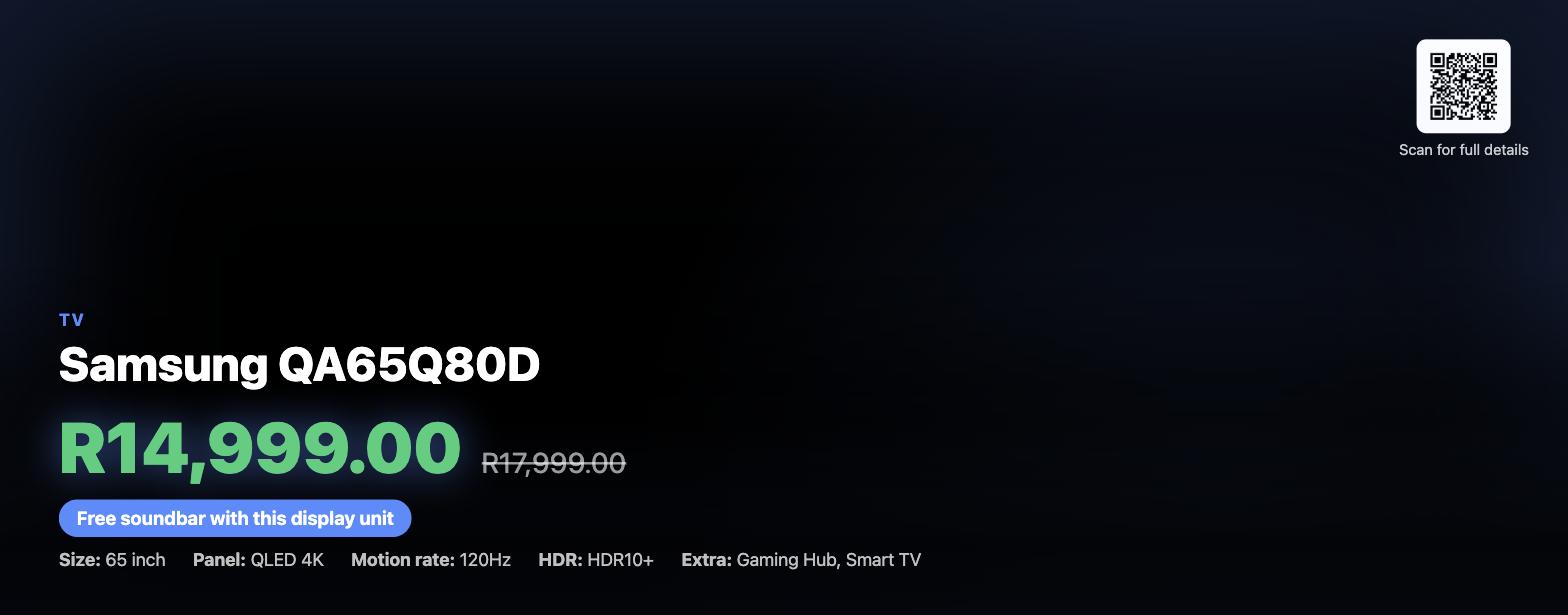
The screen itself — a real TV's browser, live, mid-cycle through a price slide with an active promotion. The same layout carries any content an operator assigns, not only pricing.
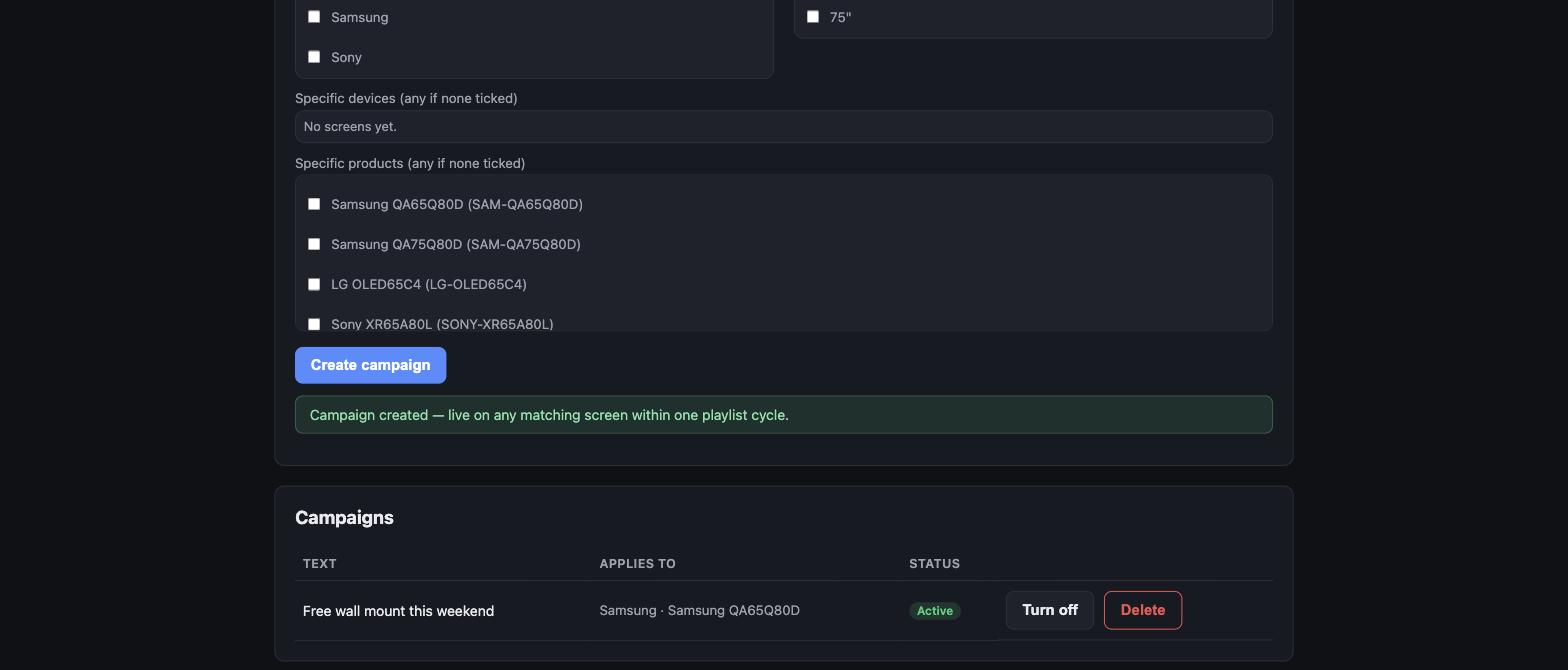
The dashboard — a live campaign rule, created once, already resolved to a specific product it matches.
Patented Technology
Hello Customer's device pairing runs on Digitag's core patent — the same mechanism behind eReceipts and our other divisions, just applied to a screen instead of a bag or a bike.
An unclaimed screen has no physical tag the way a bag or a bike would, so its own QR code
is the tag: scanning it is what allocates the device to an operator's account in our
database and switches on content delivery to it — the same generate-a-tag → scan → assign-
ownership → tamper-evident-receipt mechanism protected under South African Patent No.
2022/09555. Under the eReceipts name, this exact mechanism is what issues a digital luggage
tag at check-in; here, the "item" being tagged is the screen itself.
No CAPEX. No hardware. No rollout to plan. Sign up and go live.
There's nothing to buy, nothing to install, and nothing sitting on your balance sheet
depreciating. Every screen is a TV or laptop your locations already own, so there's no
physical hardware deployment to schedule and no capital budget to get approved before a
single screen goes live. Use one screen or every screen at every location — as much or as
little as you choose — and change your mind anytime.
No CAPEXNo Hardware to BuyNo Rollout CostsScale Up or Down Anytime
Priced per estate, once we know how many screens and where.
Bring a screen you already own, or let us ship you one — either way, you're live in days.
Hello Customer Only
Fourteen days free
For the TVs, laptops and phones your location already has. Nothing to buy, no fixed term. Growth and Professional plans sit above it when you outgrow one property.
Don't have a screen yet? We ship you a brand-new 42" Samsung Smart HD TV as part of the deal, over a 24-month term, through our retail hardware partner — no upfront cost. Priced per site once we know how many you need.
Cut the cost and error rate of keeping on-screen information accurate, wherever it lives.
One correction, made once, reaches every location instantly — no reprinting, no site left out of sync, no mismatch between what's on screen and what's true.
Centralised control across the whole network
No printing, laminating, or physical sign swaps
Specials and time-boxed offers go live and expire on schedule, automatically
Marketing & Ad Revenue
Turn floor space into media space.
Every screen is also a canvas. Advertisers and brand partners can be sold curated slots alongside an operator's own content — a new revenue line running on infrastructure the core use case already justified.
A pre-curated content library, scheduled independently per screen
Sellable ad inventory across an entire network
A QR code turns a glance into a measurable click-through
IT & Integration
Fits alongside the systems already in place.
A simple, per-tenant API key is the entire integration surface. Content can be pushed from an existing backend system on whatever schedule IT already runs — no bespoke hardware, no proprietary player software to patch.
One API key per company — push updates from your own system
Runs entirely in a standard web browser
Screens re-identify themselves automatically after any reboot
Built To Scale
Designed for a handful of screens today, and thousands across multiple operators tomorrow.
A growing network's screen count grows fast, whatever the industry — this is built with
that in mind from day one, not retrofitted later.
Each screen identifies itself with its own long random token — no shared credentials between devices
Every company's screens, content and products are isolated from every other company's
Per-tenant API keys, rate-limited, for backend-to-backend content pushes
Screens re-check for updates on an interval designed to stay light even at very high device counts
Database lookups indexed by company and by screen from the start
Security
Real, verifiable controls — not a checkbox exercise.
Every measure below is live in the product today, not a roadmap item. We'd rather list
fewer things and have every one of them be true than pad this section — this matters most
for the one integration operators are trusting us with: the content-feed API tied to their
own systems.
API keys are never stored — only a one-way hash, the same principle as a password. A database breach alone can't be used to push fake content.
An API key is shown in full exactly once, at creation or regeneration, and never again — the same model GitHub, AWS and Stripe use for their own secrets
Every feed call is logged and visible to that operator in their own dashboard — see exactly what your integration has done, not just trust it blindly
A strict Content-Security-Policy blocks inline script execution outright — the standard defense against cross-site scripting, not just a header set and forgotten
All traffic enforced over HTTPS in production (HSTS), with standard hardening headers on every response
Every dashboard action is protected against cross-site request forgery (CSRF)
Passwordless login — a one-time emailed link, so there's no password to leak, reuse, or brute-force
Every database query is parameterized — no string-built SQL, anywhere
Strict multi-tenant isolation — every lookup is scoped to the requesting company; there is no query path from one operator's session to another's data
Rate limiting on every sensitive endpoint: login, device pairing, and the content-feed API itself
One More Thing — Entirely Optional
Your screen network can also anchor your local community.
A church, a golf club, a school, a doctor's waiting room, a hair salon, a community
centre — anywhere people already sit and wait is a screen worth having. Once your network
is live, you can choose to open a slot on it to the local businesses that support each of
your locations: introduce your congregation, your members, your pupils' parents, to the
people already in the room. Charge those local businesses what you like for a slot — it's
common for that alone to cover the subscription, with room left over as a small profit.
You control who appears on your screen and what they pay
Your own content — service times, club news, class notices — sits alongside theirs
The hardware option means even a venue with no existing screen can start from zero
See it running on your own screens.
Sign up and you're live in minutes — or if you'd rather see it on a real screen first, book a time and we'll bring it to you.