What Digitag Actually Is
Digitag gives every physical item its own permanent digital identity — making ownership, custody, and authenticity provable with a single scan. Not a QR-code platform: identity infrastructure for physical objects, protected across South Africa, the EU and the US, already running in production for years tracking airline luggage at scale as eReceipts, and now powering the screen network we've built today.
Most QR codes point to one website. Ours never do.
Every copy of the same code. Every scan, every person, the same destination.
Every single tag its own destination, its own owner, its own record.
One mechanism. No industry-specific engineering required to apply it somewhere new.
A vault of unique keys is generated in the cloud ahead of time, each wired to its own URL. That batch is exported and fed into print production, where every tag — a QR code, an RFID chip, or an NFC tag — is printed offline, in bulk, and secured to or integrated with an item. The key sits dormant until an owner scans it for the first time: that scan is a claim, attaching their name and a reference — a flight number, a hotel reservation, whatever applies — to that specific tag. One owner can claim any number of tags, so someone with several bags, or several insured items, links each one back to themselves independently. Once claimed, a code can never be reassigned or duplicated, and a tamper-evident electronic receipt is issued and stored permanently — provable ownership an insurer can verify directly. Read the full patent breakdown →
The difference isn't cosmetic — it's what the code is actually capable of proving.
| Normal QR | Digitag | |
|---|---|---|
| One website for every copy | ✓ | ✕ |
| Unique identity per tag | ✕ | ✓ |
| Permanent ownership record | ✕ | ✓ |
| Tamper-evident receipt | ✕ | ✓ |
| Chain of custody | ✕ | ✓ |
| Protected technology | ✕ | ✓ |
This isn't a concept. It's been running in production for years.
Under the name eReceipts, this exact mechanism has been issuing digital luggage tags for airlines and travel operators for years — real tags, scanned repeatedly, at real airports, with no fraud or duplication of an issued code.
Operators who've used this in production include Mango Airlines, British Airways (via Comair Limited), Hertz (via CFAO Motors), and Hotel Sky, Cape Town. See the eReceipts story →
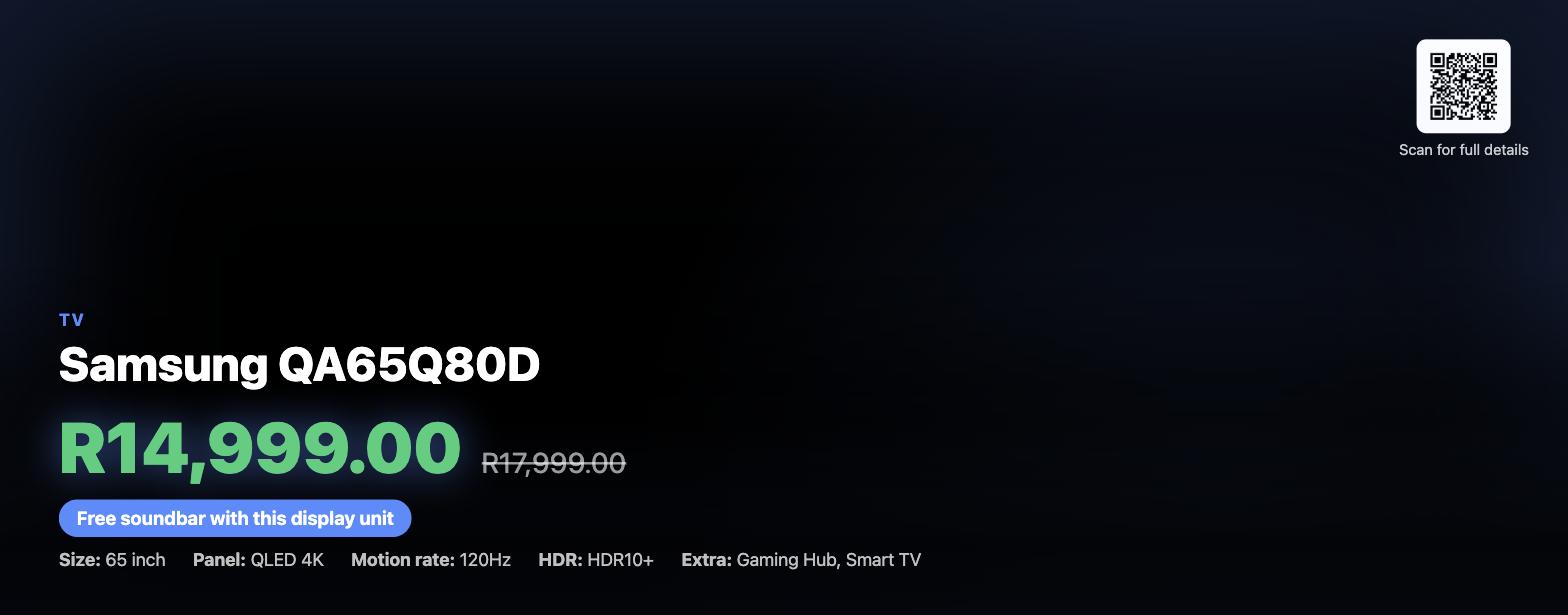
The moment its own on-screen QR code is scanned, a TV or laptop joins a real-time network — pricing, promotions, and partner content, updated everywhere in seconds.
Our first live division, built and running today — not a mockup standing in for one.
See ScreenSync →Under the name eReceipts, this exact mechanism has issued digital luggage tags for years — real named clients, real airports, no fraud or duplication of an issued code.
See the eReceipts story →Pre-printed, tamper-proof ownership labels mailed with a policy — scanned once to allocate the item to its owner, so proof of ownership exists before a claim is ever filed, not reconstructed after.
See the Insurance vertical →A tamper-proof tag applied at the point of sale, scanned once, permanently tied to the buyer — no paper receipt to lose before it's ever needed.
See the Retail vertical →A business tags its own equipment so every handover is a scan: assigned to a person, on record, with no sign-out sheet that can go missing along with the item.
See the Asset Custody vertical →The mechanism doesn't care what the item is — luggage, a screen, an insured item today; equipment, artwork, or anything else that needs a provable owner tomorrow. If your business needs to prove who owns or holds a physical item — without relying on a paper receipt — let's talk about what a Digitag division would look like for you.
Get in touch